One of the hardest things about running a company is deciding when strategy should bend to operations, and when operations should stretch to make strategy real.
A CEO’s Frustration…
“Our strategy looks great on paper. It makes sense, and we haven’t made any dramatic changes to it that would cause people to forget what it is. So why haven’t we seen any progress for the last 18 months!?”
This was the frustrated voice of a CEO I once worked with. I had been invited to a meeting with the company’s top executives to discuss an upcoming meeting with the board of directors. As you can imagine, everyone wanted that summit to be a smashing success (there are few things less fun in the world than telling your board that the company isn’t winning).
But what bothered the CEO most was that the “execution problem” didn’t feel rational. Employees weren’t rebelling. No one said the strategy was bad. And yet progress was glacial. Old habits lingered. Projects missed deadlines. Leaders kept asking, Why can’t people just do the obvious thing?
Why the Obvious Isn’t Obvious
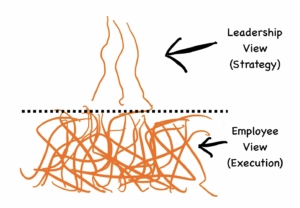
From the top, a good strategy feels like common sense. Leaders can see the forest: the markets, the competitors, the direction the business should go. And because it seems so clear they assume execution is mostly about willpower—just aligning people and pushing forward.
But beneath the forest canopy are the trees. And those trees are gnarled. The further down you go, the more complexity you find: systems that don’t quite fit together, incentives that reward the wrong behavior, regulations that quietly dictate what’s possible.
A strategy that looks simple from 30,000 feet can become a labyrinth once it reaches the ground.

This is what I call “The Hidden Complexities of Business”. Here’s a small but telling example:
A few weeks ago, my company’s COO and CRO decided we should sell annual contracts to a new segment of customers. The reasoning was straightforward: customers preferred the predictability & locked rates and the company would benefit from smoother revenue. A textbook win-win.
It was an easy decision, a no-brainer. Until I took it to the sales, accounting, and business systems teams that had to actually make that change….
There were all sorts of questions and objections:
- Accounting: “We’re not sure how this would flow through revenue recognition. It could break compliance.”
- Sales: “Our reps are trained and incentivized around month-to-month deals. To sell annuals, we’d need retraining and comp changes.”
- Business Systems: “Salesforce doesn’t handle this today. We’d need a major rework.”
The idea hadn’t been wrong. But it hadn’t been simple either. When the COO & CRO met with the team on this they were surprised at how much “under the surface” there was to this decision. The execs weren’t seeing deliberate resistance; they just were seeing complexity they hadn’t known existed.
That’s the reality of execution: every “obvious” idea has a hidden cost. And until you dig into it, you won’t know whether the cost is small friction or a show-stopper.
The Forest and the Trees
If you’ve ever worked on the front lines of a company, this probably sounds familiar. Leadership makes some shiny new plan, but to you it feels detached from reality. You want to shout: If they only knew how things actually work, they wouldn’t ask this of us!
And if you’ve ever been in leadership, you’ve felt the opposite: This is the right move. Why can’t they just execute it?
Both perspectives are valid. Leaders see the forest. Employees see the trees. The tension is structural. It’s not because leaders are stupid or employees are stubborn. It’s because both are looking from different altitudes.
The mistake is believing one side should always bend.
- Sometimes strategy has to bend. If the operational complexity is overwhelming, the smart move is to adapt. Good strategy doesn’t ignore reality—it incorporates it. That may mean slowing down, or even shelving a great idea until the company is ready.
- Sometimes operations have to bend. Every team believes its processes are critical, but if those processes become untouchable, the company never moves forward. Sometimes you have to break your own rules for the greater good.
The art of leadership is knowing which to bend (and when). What helps most with making this decision is switching perspectives. Leaders should sometimes climb down into the weeds. Employees should sometimes climb up into the forest canopy. When leaders see the messy realities of execution, they design smarter strategies. When employees glimpse the larger stakes, they’re more willing to flex their processes.
This doesn’t completely eliminate the tension. But it changes the dialogue between the two sides. Instead of endless stalemates, you get compromises and workarounds (messy, maybe, but workable).
The hidden complexity of business is like gravity: you can’t eliminate it, you can only work with it. The best companies (ironically) aren’t always the ones with the smoothest operations . They’re the ones that keep toggling between forest and trees until things line up enough to move forward.